4th Passiontide (Palm Sunday)
Matthew 21:1-11
And they approached Jerusalem and came to Bethphage by the Mount of Olives. Then Jesus sent two disciples ahead and said to them, “Go to the village which you see before you and at once you will find a donkey tied there and her foal with her. Untie them and bring them to me. If anyone says anything to you, tell him that the Lord needs them, and he will let you take them right away.”
This took place to fulfill what was spoken through the prophet:
 |
| Filipo Lippi |
‘Say to the daughter of Zion,
Behold, your king comes to you in majesty.
Gentle is He, and He rides on a donkey and a foal of the beast of burden.’
The disciples went and did as Jesus had instructed them. They brought the donkey and the foal, placed their garments on them, and Jesus sat on them. Many out of the large crowd spread their clothes on the road, while others cut branches from the trees and spread them on the road. The crowds that went ahead of them and followed Him shouted:
Hosanna to the Son of David!
Blessed is he who comes in the Name and Power of the Lord!
Hosanna in the highest! [Sing to Him in the highest heights!]
When Jesus entered Jerusalem, the whole city was stirred and asked, “Who is he?” The crowds answered, “This is Jesus, the prophet from Nazareth in Galilee.”
4th Passiontide
Palm Sunday
April 5, 2020
Matthew 21:1-11
The images and pictures of Holy Week reveal a secret. In mythology, the donkey is a symbol for the physical body – Brother Ass, as St. Francis called it.
 |
| Buongiorno |
Currently, concern for the body dominates our consciousness. Many of us may feel ourselves submerged, overwhelmed within our bodies. Perhaps the body feels like a runaway donkey dragging our spirits along. Or perhaps, if we are ill, and especially as we get older, we may feel our body as a burden that we are coaxing or even dragging along behind us like an unwilling and stubborn animal.
Christ came to help human beings establish a new relationship with their physical nature. The image of Christ riding the donkey and its foal in majesty is a picture of our own future. We will gradually lovingly and gently master our bodily nature. It will carry us where we decide to go. And at the same time, through Christ, we will each develop a new body, a resurrection body. The gospel image of the new young foal alongside its mother even hints at the future development of this new kind of body.
 |
| Grunewald |
Here at the beginning of Holy Week, Christ directs His body toward Jerusalem and its Temple. He directs it willingly and knowingly toward the place His own death. After today He will enter and leave Jerusalem every day on foot until late Thursday, when he will remain, entering into the body’s death process. And at the moment of death, His birthing of a new kind of body, the resurrection body, will begin. Step by step we can accompany this process, for
Behold, your king comes to you in majesty.
Gentle He is,
and he rides on a donkey
and on a foal of the beast of burden. Matthew 21:5
www.thechristiancommunity.org
 |
| Rembrandt |
3rd Passiontide
John 8:1-12
Jesus returned to the Mount of Olives, but as soon as day dawned, he was already in the Temple court, where the people flocked to him, and he sat down and began to teach them. The teachers of the law and the Pharisees led in a woman caught in adultery. They made her stand in the middle, and said to Jesus, “Teacher, this woman was caught in the act of adultery. In the law, Moses commanded us to stone such women. Now, what do you say?” They said this only as a trap, in order finally to have a reason for accusing him.
But Jesus bent down and started to write something into the earth with his finger. When they kept on pressing him with questions, he stood up and said to them, “Whoever among you is without sin, let him cast the first stone at her.” And again, he bent down and wrote into the earth.
 |
| Dore |
When they heard this, their conscience began to stir within them, and they went out, one after the other, beginning with the eldest. And only Jesus was left and the woman who stood in the middle. Jesus stood up and said to her, “Woman, where are they? Has no one passed judgment on you?”
“No one, sir,” she said.
Then Jesus declared, “Neither do I condemn you. Go now and leave your life of sin.”
And Jesus began to speak to them again: “I am the light of the world; he who follows me will not walk in darkness but have the light in which there is life.”
3rd Passiontide
March 31, 2020
John 8, 1-12
A fruit-bearing tree goes through its stages. When the fruit is green, it may drop. When fruit is ripe, it will drop. When overripe, the fruit drops and spoils. We do not blame the tree for dropping its fruit. We do not pass judgment or punish the tree because of its overripe fruit spoils. The tree is bound to follow the natural course of events.

In a certain sense, our deeds exist in a kind of hidden natural realm, a realm that has its own lawfulness. Our sins, our errors, our failures are a bit like fruit. Some of them come from our greenness, our immaturity. Some of them come from our over-ripeness. It is as useless to pass judgment and dole out punishment as it is to stone a tree that has dropped its fruit. Punishment doesn’t change anything. What is needed is understanding, a kind of wisdom, and a desire to help.
When we understand where someone’s ‘sins’ come from, including our own; when we understand how the state of their inner nature, their weakness or misguided errors, led them to do what they did, then we can begin to let go of the need to accuse. We can let go of our demand for retribution. For just as fallen fruit contains a seed within it, so does our deed. The deed itself will, in time, call forth its own compensation.
All of our deeds, good and bad, contain within them the seed of their required compensation, the seed of their karmic balancing. Like the elders in the gospel story, we are not required to be the enforcers of others’ karma. The universe, as God created it will do that.
Our
 |
| Mariusz Lewandowski |
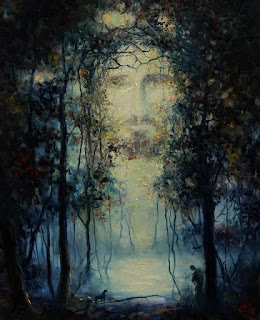
deeds fall with their seeds literally into the earth itself. The earth is Christ’s body. He takes into Himself our fallen fruit, green, ripe, overripe. The great law of the universe says that all deeds call forth their compensation. So Christ does not, cannot remove the necessity of our compensating for our deeds in the future. But by taking on our sins, our propensity for evil driven by weakness, Christ sees to it that the damage to the earth and to ourselves is contained. He sees to it that we never lose the power to continue to grow and bear fruit, good fruit, no matter how rotten the things we have done.
A truly Christ-inspired attitude toward the sinner (ourselves included) is not to play judge and executioner, but rather to understand. We need to understand that we all are flawed. We need to understand that the universe will provide the opportunity for balancing the deed in the future; to understand that it is far more helpful to work to overcome the causes of failures, errors, weaknesses in myself, for the sake of others. It is essential to strengthen myself and others through Christ so that like the woman in the Gospel, we can walk forward into the future in Christ’s light.
www.thechristiancommunity.org
 |
| Bradi Barth |
The universe only pretends to be made of matter. Secretly it is made of love. (Daniel Pinchbeck?)Creator said, “I want to hide something from the humans until they are ready for it. It is the realization that they create their own reality.”The eagle said, “Give it to me. I will take it to the moon.” Creator said, “No. One day they will go there and find it.”The salmon said, “I will bury it on the bottom of the ocean.” Creator said, No, they will go there, too.”The buffalo said, “I will bury it on the Great Plains.” Creator said, “They will cut into the skin of the earth and find it even there.”Grandmother who lives in the breast of Mother Earth and who has no physical eyes but sees with spiritual eyes, said, “Put it inside of them.” And Creator said, “It is done.”- Creation story from the Hopi Nation, Arizona
 |
| Rembrandt |
3rd Passiontide
John 8: 1-12
Jesus returned to the Mount of Olives, but as soon as day dawned, he was already in the Temple court, where the people flocked to him, and he sat down and began to teach them. The teachers of the law and the Pharisees led in a woman caught in adultery. They made her stand in the middle, and said to Jesus, “Teacher, this woman was caught in the act of adultery. In the law, Moses commanded us to stone such women. Now, what do you say?” They said this only as a trap, in order finally to have a reason for accusing him.
But Jesus bent down and started to write something into the earth with his finger. When they kept on pressing him with questions, he stood up and said to them, “Whoever among you is without sin, let him cast the first stone at her.” And again, he bent down and wrote into the earth.
 |
| Breugel |
When they heard this, their conscience began to stir within them, and they went out, one after the other, beginning with the eldest. And only Jesus was left and the woman who stood in the middle. Jesus stood up and said to her, “Woman, where are they? Has no one passed judgment on you?”
“No one, sir,” she said.
Then Jesus declared, “Neither do I condemn you. Go now and leave your life of sin.”
And Jesus began to speak to them again: “I am the light of the world; he who follows me will not walk in darkness but have the light in which there is life.”
3rd Passiontide
March 29, 2020
John 8: 1-12
If someone adds something to food or drink to thin it out or to poison it, we say that it has been adulterated. It has been watered down or made harmful.
Over millennia, humanity's soul has been adulterated. The forces of humankind's adversary have inserted the thorn of evil, the sting into our hearts. It is a wound.
 |
| Bradi Barth |
Because of this wounding, we have become weak. We are both 'watered down,' not fully potent, and at the same time capable of harm.
Christ came to the earth to experience what it is like being a human being in a body of flesh. He knows in depth the underlying human condition of weakness. And its capacity for evil. Yet in His empathy and compassion, He does not judge us. Instead, He seeks to give us strength, to heal us, to raise us.
Given the current world situation, we may now feel contracted in grief. Now is our time of suffering. Yet, like the woman in the gospel reading, we must realize that collectively we have brought this on ourselves. We all have succumbed at some point to self-centered desires and lack of compassion. However innocently, we have all contributed to evil.
And yet, as always, Christ stands in our midst, offering strength and healing to our souls and spirits. He gives us the opportunity to move beyond the self-centered desires, the restless pleasure-seeking, the judgmental anger, and self-pity. We have been adulterated. He offers us the strength to change our ways, become our better selves. Keep going, He says. Separate yourselves no longer from a right relationship to Me, to others, to the world.
In the words of the poet, we may say to Him:
My heart is so small
 |
| Fra Angelico |
it's almost invisible.
How can You place
such big sorrows in it?
Yet He answers:
"Look, … your eyes are even smaller,
yet they behold the world."*
Eventually, with Him, we will rise and expand.
* Rumi, in Whispers of the Beloved, by Maryam & Azima Melita Kolin
www.thechristiancommunity.org