Sunday, July 12, 2020

3rd Johnstide 2020, Burden of Love

Click here for Audio Version

Johnstide

John 1:19-39

This is the testimony of John when the Jewish leaders sent priests and Levites from Jerusalem to ask him, “Who are you?” Freely and openly, he confessed. He did not deny but confessed, “I am not the Christ [the Anointed].”

Then they asked him, “Who are you then? Are you Elijah?” And he said, “No, I am not.” “Are you the prophet?” He answered, “No.”

John the Baptist, Hieronymous Bosch

Then they said, “Who are you? What answer are we to give to those who sent us? What do you say about yourself?”

He said in the words of the prophet Isaiah, “I am the voice of one crying in the loneliness: Prepare the way for the Lord [so that the Lord may enter into the inmost soul [self].”

And those who had been sent by the Pharisees asked him, “Why do you baptize if you are neither the Christ, nor Elijah, nor the prophet?”

John answered them, “I baptize with water. But someone is standing in your midst whom you do not know, who comes after me although he was before me. I am not worthy even to untie the strap of his sandals.”

This took place in Bethany near the mouth of the Jordan, where John was baptizing.

The next day he [John] sees Jesus coming to him and says, “Behold the Lamb of God who takes upon himself the burden of the sin of the world. He it is of whom I said: ‘After me comes one who was before me, for he is greater than I  [for he is ahead of me].’ [After me comes one who was (generated) before me, for he is the prototype.] Even I did not know him; but for this, I have come, and have baptized with water so that human souls in Israel might become able to experience the revelation of his being.”

And John testified: “I saw how the Spirit descended upon him like a dove from the heavens and remained united with him. I did not know him, but he who sent me

Julia Stankova, Baptism of Christ
to baptize with water said to me, ‘He on whom you see the Spirit descend so that it remains united with him, he it is who baptizes with the [breath of the] Holy [Healing] Spirit.’ And I saw this, and so I testify that this is God’s Son.”

The next day John was again standing there, and two of his disciples were with him. And as he saw Jesus walking past, he said, “Behold, the [sacrificial] Lamb of God [through whom humanity’s sense of self will be purified.]

The two disciples heard him say this, and they followed Jesus. Then Jesus turned and saw them following and said to them, “What are you seeking?” They answered, “Rabbi [Teacher], where are you staying [where do you live] [where do you take refuge]?”

He said, “Come, and you will see!” And they came and saw where he stayed [lived], and remained with him all that day. It was about the tenth hour [four o’clock].

3rd Johnstide

July 12, 2020

John 1:19-34

Tissot, John the Baptist Preaching
Today’s reading begins with questions about identity. The Hebrew leadership asks John the Baptist who he is. In all humility, he acknowledges that he is not the Messiah, the anointed one of God. They ask him if he is Elijah, who was to precede the coming of the Messiah. And although Christ says later that ‘ he is Elijah who was to come,’* either John no longer remembers his previous existence, or else he is making the claim that he is no longer working in the grandiose style of the great prophetic leader of the Hebrews. Instead, he claims to be a single voice, speaking from a lonely and deserted place, saying: Make preparations.  John is who he is; he voices what needs to be said in the moment. He awakens our sense of personal responsibility.

In fact, John the Baptist epitomizes the state of the modern soul. We are who we are, now. We no longer remember previous lives—we may not even remember our current yesterdays! John in us is the single voice in us, speaking in the now, telling ourselves that we must prepare ourselves so that Christ can enter into us and abide in us.

We need to strengthen and create order in our thoughts, in our feeling life, so that an inner space arises, a space that stretches into a path for the entry of the Lamb of God. Christ came as the Lamb in order to carry the burden of human separation from the divine. This separation from the divine has created our capacity for our sins, our failings, our weaknesses. It creates our errors and our denials of the divine.

Christ, the divine Son, the God, would enter our souls so as to overcome our lonely separateness, and to reunite us with humanity’s Father. We open our souls to him. We strengthen and order our souls’ forces so that our thinking, our feeling, and our willing can become strong, weight-bearing, enduring; so that we, with Christ, can peacefully and lovingly carry the burden of the sin of the world. For as the poet says:

The weight of the world

John the Baptist, Anton Mengs

is love.

Under the burden

of solitude,

under the burden

of dissatisfaction


the weight,

the weight we carry

is love.**


* Matthew 11:14

** “Song”, Allen Ginsberg, in Collected Poems 1947-1980

www.thechristiancommunity.org


Sunday, July 5, 2020

2nd Johnstide Homily 2020, Spirit Creates Order

2nd Johnstide

Matthew 3:1-17

In those days, John the Baptist came. He proclaimed his message in the isolation of the Judean desert. He said, “Change your hearts and minds. The realm of [the human being filled with] the heavens has come close.”

He it is of whom the prophet Isaiah speaks:

A voice is heard, calling in the loneliness [of the human soul]: ‘Prepare the way for the highest leader [within the soul], make his path straight and good [Order your feeling and thinking, so that within you a path arises for the inner Lord!].

John wore a garment of camel’s hair and a leather girdle around his waist. Hard fruits and wild honey were his food.

At that time, people came out to him from Jerusalem and the whole of Judea and from the region around the Jordan, and they were baptized by him in the flowing waters of the Jordan and confessed [admitted] their sins [failings, and the errors of their lives].

When he saw that many Pharisees and Sadducees also came for baptism, he said to them, ‘You sons of the serpent, who has told you how to escape from the coming World-Fire [Fury]? Now, therefore, strive after [to bring forth] the right fruits of the change of heart and mind. Do not think that you are safe by saying: We have Abraham as our father. I say to you: the heavenly Father is just as able to raise Abraham-sons from these dead stones. Already the ax is laid to the root of the trees [of the bloodlines], and every tree that does not bear good fruit is felled and thrown into the fire [of testing]. I baptize you with water to lead you to a change of consciousness [heart]. He who comes after me is mightier than I; unworthy am I even to carry his sandals. He will baptize you with the Holy Spirit and with fire. His winnowing fork is in his hand, and he will cleanse his grain of the chaff. He will gather the wheat into the barn [for the future], but the chaff he will burn in an unquenchable fire.”

Then Jesus came from Galilee to the

Icon, Baptism in the Jordan
Jordan to John, to be baptized by him. But John refused and said, “It is I who need to be baptized by you—and now you come to me?”

Jesus answered him, “Let it be so now. It is good thus so that we fulfill properly all that destiny [divine righteousness] requires.” Then he consented.

Having been baptized Jesus was already coming up from the water again when behold, the heavens opened to him, and he saw the Spirit of God descending in the form of a dove and alighting upon him. And a voice spoke out of the heavens:     

“This is my Son whom I love,

            [Today I have conceived him. Luke 3:22]

In him will I reveal myself.”


2nd Johnstide

July 5, 2020

Matthew 3:1-17

At the end of the day's work or a big project, the environment may have become disordered.  Clean-up is called for. A visitor to one of the original Waldorf curative schools was told that he could find the school's founder and teacher after-school still in the classroom, cleaning up. As the visitor approached, he could hear the teacher repeating a phrase again and again: The Spirit creates order! The Spirit creates order!

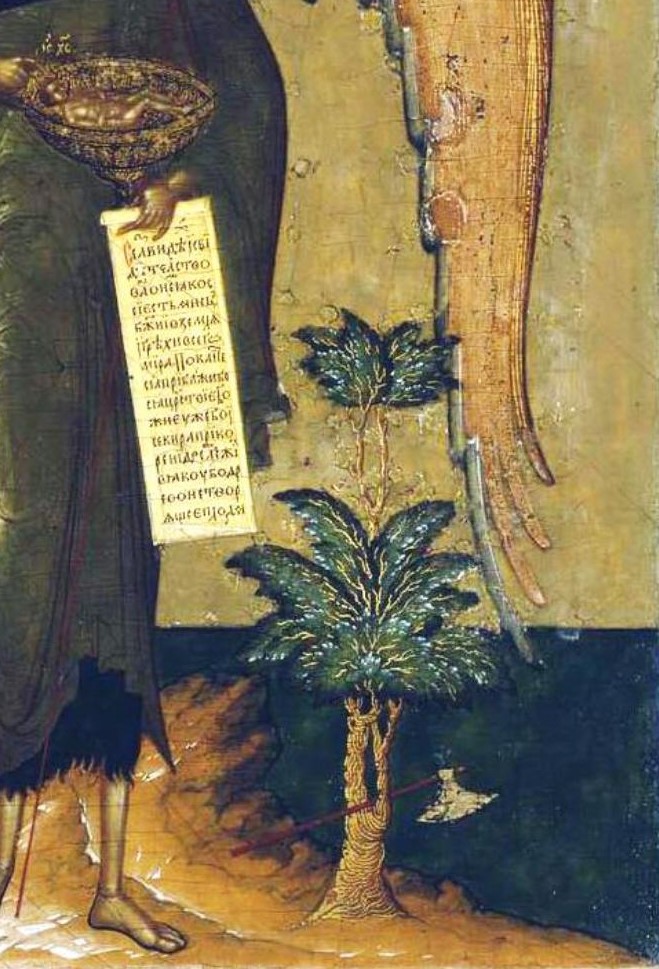
Icon,John the Baptist, Angel of the Desert, detail

Today's gospel reading describes such a moment in human history. The old phase of the elite bloodlines is over; their work is done. John the Baptizer said, "The ax has been laid to the roots of the trees," the ancestral trees of the bloodlines. This is because their mission, that of creating a pure bodily form for the Messiah, is complete. After this, there can only be decay; for the bloodlines are no longer capable of spiritual awareness.

Yet a new order is arriving. The Spirit creates order! Jesus comes to the Jordan as the beginning of a new era for human beings. Christ, the divine Son and our Brother, will enter humanity. Everything will be up-ended. Even John the Baptizer's perception of his own unworthiness is no hindrance. Now a new order, a new Spirit consciousness, has arrived. Now the divine will inhabit the body. Now heaven can reveal itself on earth, for a new spirit consciousness of love for all human beings, beyond bloodline, tribe, or nation, will slowly and gradually take over the earth. 

It is true that elitism, tribalism, and nationalism will ever try to interfere with the new order. But they have no future. Only the Spirit creates order. Now is the time to recognize that all of humankind is one family, for we are all children of God. Here the 15th Psalm is a kind of prophecy: 

Lord, who can be trusted with power,

Codex Rossanensis, Christ as Good Samaritan

and who may act in your place?

Those with a passion for justice,

who speak the truth from their hearts;

who have let go of selfish interests

and grown beyond their own lives;

who see the wretched as their family

and the poor as their flesh and blood.

They alone are impartial

and worthy of the people's trust.

Their compassion lights up the whole earth,

and their kindness endures forever.*


*Psalm 15, in The Psalms, translations by Stephen Mitchell


Sunday, June 28, 2020

1st Johnstide 2020, I am not I

1st Johnstide

Mark 1:1-13

This is the beginning of the new word from the realm of the angels, sounding forth through Jesus Christ. Fulfilled is the word of the prophet Isaiah:


Behold, I send my angel before your face.

He is to prepare your way.

Hear the voice of one calling in the loneliness of the human soul

Prepare the way for the Lord within the soul,

Make his paths straight, so that he may find entrance into the innermost human being!

 Thus did John the Baptist appear in the loneliness of the desert. He proclaimed Baptism, the way of a change of heart and mind, for the acknowledgment of sin. And they went out to him from all of Judea and Jerusalem and received baptism from him in the river Jordan and recognized and confessed their failings.

John wore a garment of camel’s hair and a leather belt around his waist. Fruits and wild honey were his food. And he proclaimed:     

‘After me comes one who is mightier than I. I am not even worthy to bend down before Him and to undo the straps of His sandals. I have baptized you with water,

but He will baptize you with the fire of the Holy [healing] Spirit.’

In those days it happened: Jesus of Nazareth came to Galilee and was baptized in the Jordan by John.

And at the same time, as he rose up again out of the water, he beheld how the spheres of the heavens were torn open, and the spirit of God descended upon him like a dove.

And a voice sounded from the world of the spirit:

‘You are my son, the beloved - in you is my revelation.’ [‘Today I have conceived (begotten) you.’ Luke 3:22]


St. Johnstide

June 28, 2020

Mark 1: 1-11

As we grow older, our awareness expands. Imagine going back in time to visit our younger self. Imagine what we would want to say to that younger self out of our years of experience since our youth. Imagine how possibly painful our older self-awareness would be in the face of our former innocent intentions. And imagine how terrified our younger self would be to encounter this someone from the future who is so strangely familiar, who so intimately knows us.

John the Baptist is humankind’s older self. He is the older self who has gone ahead of us. He has something he wants to say to us. He is acutely aware of his own and humankind’s failings. Out of his broader awareness, he encourages us to change our way of thinking, to undergo a change of heart. This is all in preparation for an encounter with Christ Jesus, the innocent younger self of humankind.

John encounters the innocence of Jesus,

and the enormity of the spirit of God that descends upon Jesus like a dove. The result for this older self of John is a deepening of humility. ‘I am not worthy’, he says. I am doing my best to serve what God has as intention for humankind. But HE is the embodiment of the pure and grand intentions of the Godhead. He is the true prototype.  And thus He is even before me. He is my own younger self as God intended me to be.

We can experience painful self-awareness of our shortcomings, our failures to be what both God and we intended to be; and at the same time, this is a deep experience of God’s love for us, His willingness to sacrifice Himself for us, so that we can start over, begin again to be what we, and He intended us to be.

We shy away from such encounters; such painful self-awareness terrifies us; and to be so intimately known can be devastating. But it is a necessary step on the way to experiencing the mildness, the acceptance, the calm radiant forgiveness of the One who is our ideal future self. Such self-awareness is a necessary passage into the forgiveness that allows us to start over, to begin at the beginning again. It is the experience of what the poet Juan Ramon Jimenez speaks of when he says: 


I am not I.

I am this one walking beside me whom I do not see,

Whom at times I manage to visit,

And whom at other times I forget;

The one who remains silent when I talk

The one who forgives, sweet, when I hate,

The one who takes a walk where I am not.

The one who will remain standing when I die.*


* “I Am Not I”, by Juan Ramón Jiménez, in Risking Everything, ed. By Roger Housden, p. 19.