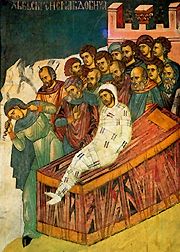
Thursday, October 29, 2015

10th August September Trinity 2008, Ripen Death

10th Trinity August September
wikicommons
Luke 7, 11-17

And it came to pass that on the next day Jesus went into a city called Nain, and his disciples and a large crowd went along with him. And as he drew near to the gate of the city, they became aware that a dead man was being carried out—the only born son of his mother, and she was a widow. And a large crowd of people from the city accompanied her.

And seeing her the Lord felt her suffering, and said to her, “Weep no more.”

And approaching, he touched the coffin, and pallbearers stood still. He said, “Young man, I say to you, arise!”

The dead man sat up, and began to speak. And Jesus gave him to his mother. Astonishment and awe seized all who were standing there, and they began to praise God and to glorify what was here revealed, saying,

“A prophet powerful in spirit has been raised among us, and God has come down to us, his people.”

Word about him spread out into all of Judea and all of the neighboring regions.


10th August Trinity
September 28, 2008
Luke 7: 11 -17

During the course of the year, some fruits drop early, while they are still green. Others go on to ripen and mature.

The only place in the universe where a living being can experience death is here on the earth. We carry this death inside us. As the poet Rilke says:

We are only the rind and the leaf.
The great death that each of us carries inside is the fruit.
Everything enfolds it.[1]

The angels in heaven cannot die. Christ had to come to earth as a human being in order to be the only heavenly being to go through death, to ripen it and harvest it. He went through death as a human so that humans could live through death and rise.

In today’s reading, Christ encounters a young man, a sort of green fruit, who had dropped early. This young man had died before really finishing his life’s task. Christ appeared at the crucial moment and infuses him with new life – “Young man, I say to you, arise!”  He helps him maintain and complete what he himself could not do out of his own forces. He helps him maintain and complete his life. The young man was given another opportunity to mature and ripen. The poet:

We stand in your garden year after year.
We are trees for yielding a sweet death.
But, fearful, we wither before the harvest.

Dying is strange and hard
If it is not our death, but a death
That takes us by storm, when we’ve ripened none within us.[2]

We all carry death within us— like a fruit waiting to ripen. Inside the fruit is the seed of ongoing life, eternal life. Eventually the old useless husk of our egotism cracks and must be cast off. We must die to our own selfishness. Paradoxical as it sounds, we are meant to ripen the fruit of dying, so that we can live. And so the poet says:


[1] Rainer Maria Rilke, Rilke’s Book of Hours, Love Poems to God, transl. by Barrows and Macy, p. 132.
[2] Ibid. pg. 133.

10th August/September Trinity 2009, Last Fruits

10th Trinity August September
Luke 7, 11-17

And it came to pass that on the next day Jesus went into a city called Nain, and his disciples and a large crowd went along with him. And as he drew near to the gate of the city, they became aware that a dead man was being carried out—the only born son of his mother, and she was a widow. And a large crowd of people from the city accompanied her.

And seeing her the Lord felt her suffering, and said to her, “Weep no more.”

And approaching, he touched the coffin, and pallbearers stood still. He said, “Young man, I say to you, arise!”

The dead man sat up, and began to speak. And Jesus gave him to his mother. Astonishment and awe seized all who were standing there, and they began to praise God and to glorify what was here revealed, saying,

“A prophet powerful in spirit has been raised among us, and God has come down to us, his people.”

Word about him spread out into all of Judea and all of the neighboring regions.

10th August-September Trinity
Sept. 27, 2009
Luke 7: 11-17

Fruits of the vine are ripe. They enclose the seeds for new life. In nature, the fruit falls and dies away, releasing the seeds to begin a new cycle of life. But they can also be tended and harvested to another purpose—to be made into wine.

Today we hear of the young man, the fruit of whose life had fallen green. Christ catches his soul; He finds the soul’s seed of the new, and plants it again on the earth. This is Christ as the great Gardener. He is tending a harvest for his Wine. But no matter whether the soul’s fruit falls early or late, He is concerned with ongoing life, with the seeds within; He preserves them, carrying them and planting them where they next need to go.

In one lifetime, we may ripen soul fruits of many kinds. When ripe, the fruits must separate from the vine on which they grew, for their current cycle is finished. Things end, sometimes painfully. But what is valuable in our soul, the ripened sweetness, we can offer for the wine harvest. Our soul’s purest thoughts, our most noble feelings, the dedication of our will, form the sweetness of the soul’s fruit. These we can offer for the wine. What is viable in our soul fruit, seeds for the future, are gathered up by our angel, under the direction of the Master Gardener. They will be preserved, to be planted, to grow and develop. It may be in another place and time. It may be for an entirely new and different purpose. But even in all of life’s apparent endings, the living seeds are not lost. Knowing this, we can keep trying, keep working to ripen our inner fruit, developing the sweetness, even late in whatever cycle we find ourselves.

So now, in all the layers of our autumns, we can say with Rilke:

Lord: it is time. The summer was great.
Lay your shadows onto the sundials….
Command the last fruits to be full,
give them yet two more southern days,
urge them to perfection, and chase
the last sweetness into the heavy wine.[1]


[1] Rilke, “Autumn Day”, translated by J. Mullen

Wednesday, October 28, 2015

10th August/September Trinity 2011, Blaze and Deepen

10th Trinity August September
Schnorr von Carolsfeld
Luke 7, 11-17

And it came to pass that on the next day Jesus went into a city called Nain, and his disciples and a large crowd went along with him. And as he drew near to the gate of the city, they became aware that a dead man was being carried out—the only born son of his mother, and she was a widow. And a large crowd of people from the city accompanied her.

And seeing her the Lord felt her suffering, and said to her, “Weep no more.”

And approaching, he touched the coffin, and pallbearers stood still. He said, “Young man, I say to you, arise!”

The dead man sat up, and began to speak. And Jesus gave him to his mother. Astonishment and awe seized all who were standing there, and they began to praise God and to glorify what was here revealed, saying,

“A prophet powerful in spirit has been raised among us, and God has come down to us, his people.”

Word about him spread out into all of Judea and all of the neighboring regions.


10th August Trinity
September 25, 2011
Luke 7:11-17

In autumn, nature presents to us two gestures. The first are its fruits and seeds, falling to earth as nature dies back. They are an offering of continuing life for the next season. The other gesture manifests as the leaves, transforming themselves, offering themselves up to the living atmosphere as a blaze of color, before they become the humus for next round.

Today’s reading presents us with two similar gestures. The young man’s body is about to be offered up to the earth, as a kind of seed for the earth’s future. At the same time, Christ says to him, ‘Arise’. And he rises, both within the realm of death, and also to life on earth. He returns in a blaze of life and speech. And this event spreads over the countryside like the flaming colors of autumn over the land. Death and life begin to interpenetrate one another in a process that will culminate in Christ Jesus’ own resurrection.

When the hours become dark, we can welcome them as a time of deepening and transformation, especially as we grow older. As Rilke says:

I love the dark hours of my being.
Smitty Caboose
My mind deepens into them.
There I can find, as in old letters,
the days of my life, already lived,
and held like a legend, and understood.

Then the knowing comes: I can open
to another life that's wide and timeless.

So I am sometimes like a tree
rustling over a gravesite
and making real the dream
of the one its living roots
embrace:

a dream once lost
among sorrows and songs.[1]

Visit our Website


[1]   Rainier Maria Rilke, in Rilke’s Book of Hours:Love Poems to God, trans. by Anita Barrows and Joanna Macy)


Monday, October 26, 2015

10th August Trinity 2015, Death Makes Us Whole

10th Trinity August, September
Luke 7, 11-17

Schnorr von Carolsfeld Bible 
And it came to pass that on the next day Jesus went into a city called Nain, and his disciples and a large crowd went along with him. And as he drew near to the gate of the city, they became aware that a dead man was being carried out—the only born son of his mother, and she was a widow. And a large crowd of people from the city accompanied her.

And seeing her, the Lord felt her suffering, and said to her, “Weep no more.”

And approaching, he touched the coffin, and pallbearers stood still. He said, “Young man, I say to you, arise!”

The dead man sat up, and began to speak. And Jesus gave him to his mother. Astonishment and awe seized all who were standing there, and they began to praise God and to glorify what was here revealed, saying,

“A prophet powerful in spirit has been raised among us, and God has come down to us, his people.”

Word about him spread out into all of Judea and all of the neighboring regions.


10th Trinity August, September
September 27, 2015

Luke 7, 11-17
  
Death is a great mystery to us. It is also a great masquerade. The being of death is a pretender.
In today’s reading, a young man has died. One senses the communal loss and anguish. He is now ‘outside’, out beyond the city gates, beyond the crowd and his bereft and widowed mother. But he is not beyond Christ. Christ approaches him in death and bids him live, to rise above what would bind him and hold him down.

We too go through our dying times, even in life; times when we suffer the paralysis of grief; times when our former life dies away from us. And for us too, Christ approaches, especially just at such times. He bids us rise from our sleep, our grief, from our deaths.

For He is the master of the cycle of life, death and life again. Living things die; they fall, but like seeds. And from them a new life germinates. We die our smaller and greater deaths, but new life is already germinating within us, through Christ. For in our funeral service He says, I am the New Birth in Death. I am the Life in dying. As Novalis says,

What dropped us all into abyssmal woe,
Pulls us forward with sweet yearning now.
In everlasting life death found its goal,
For thou art Death who at last makes us whole.[1]


[1] Novalis, in Hymns to the Night.