Sunday, April 17, 2022

Easter Sunday 2022, I Am Not I

 Easter Sunday

Mark 16:1-18 

And when the Sabbath was over,

Julia Stankova
Mary Magdalene, Mary the mother of James, and Salome bought spices so that they might go and anoint Him. And very early on the first day of the week, they went to the tomb just as the sun was rising. And they said to one another, "Who will roll away the stone for us from the door of the tomb?" 

And looking up, they saw that the stone was rolled back—and it was very large. And they went into the tomb. There they saw a young man sitting on the right side, clad in a white robe, and they were beside themselves with amazement. And he said to them, "Do not be startled; you seek Jesus of Nazareth the Crucified One. He is risen; He is not here; see, there is the place where they laid Him. But go and say to his disciples and Peter, 'He will lead you to Galilee. There you will see Him as He promised you.'" 

And they went out and fled from the tomb in great haste, for trembling and astonishment had come upon them, and being awestruck, they were unable to say anything to anyone about what they had experienced. 

When He had risen early on the first day of the week, He appeared first to Mary Magdalene from whom He had driven out seven demons. And she went and told those who had walked with Him, as they mourned and wept. But when they heard that He was alive and had been seen by her, their hearts could not grasp it. 

Julia Stankova
After this, He appeared in another form to two of them on the way as they were walking over the fields. And they went back and told the rest, but they could not open their hearts to their words either. Afterward, He appeared to the eleven themselves as they were celebrating the meal. He reproached them for their lack of openness and their hardness of heart because they had not wanted to believe those who had seen Him, the Risen One. 

And He said to them, "Go into all the world and proclaim the new message from the realm of the angels to the whole of creation. Whoever unites their heart with it and is immersed in me will attain salvation. But whoever closes themselves against it [or, does not let the power of selflessness into his heart, or, does not let the power of My Self into his heart] will meet their downfall. And spiritual powers will stand by those who unite themselves with it and will attend their path: Through the power of my being they will drive out demons; they will speak a new language; serpents they will make upright, and poisons they drink will not harm them. They will lay their hands on the sick and give healing forces to them."*

Easter Sunday

April 17, 2022

Mark 16:1-18 

Sombart
Christ Jesus was entombed in a cave with
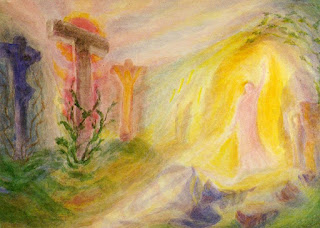
a large stone rolled over the entrance. When He rose, His rising was accompanied by an earthquake. The foundations of the world were shaken by this mighty event, for Death itself had been infused with a new form of Life. An angel rolls back the stone, revealing the place where the transformation of the world had taken place. The earth shone with a new light.
 

The cave is also a picture of the human heart. Each year Christ dies into us, is buried in each and every one of us. And every year at Easter, He rises in and through us. 

Who rolls away for us the stone from the tomb of the heart, the stone of hardness of heart, the stone of not wanting to believe and trust that He lives? 

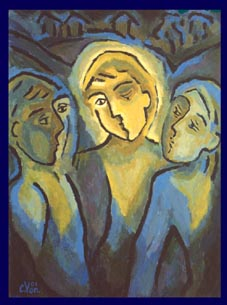
He who was entombed is now alive, in us, and everywhere. He lives in the very light that shines, in the very air we breathe. He walks in the spirit before us. We seek to find Him, for He is the very meaning and essence of our true being. We know that without Him, we are not complete. We know, in the words of the poet: 
Corrine Vonaesch
I am not I.

                I am this one walking beside me whom I do not see,

Whom at times I manage to visit,

And whom at other times I forget;

The one who remains silent when I talk

The one who forgives, sweet, when I hate,

The one who takes a walk where I am not.

The one who will remain standing when I die.* 


The One who walks beside me, before me—He whom I do not see—because of Him, I know that the grave is empty. Because of Him, the heart is full. In Him, I too will rise, through Him, into new life.

 https://www.thechristiancommunity.org/christian-festivals/


*Traditional translation: "Go into all the world and preach the good news to all creation. Whoever believes and is baptized will be saved, but whoever does not believe will be condemned. And these signs will accompany those who believe: In my name, they will drive out demons; they will speak in new tongues; they will pick up snakes with their hands, and when they drink deadly poison, it will not hurt them at all; they will place their hands on sick people and they will get well."

**“I Am Not I,” by Juan Ramón Jiménez, in Risking Everything, ed. By Roger Housden, p. 19.

Thursday, April 14, 2022

Good Friday 2022, The Godhead Is My Sap


Holy Week, Good Friday

John 19:1-15 

Tissot
Then Pilate took Jesus and had him scourged.
The soldiers braided a crown of thorns, put it on his head, threw a purple cloak around him, walked up to him, and said, "Hail, King of the Jews!" and struck him in the face. 

And again, Pilate went out to them and said, "Behold. Thus I bring him out to you so that you may know that I find no guilt in him." And Jesus came out, wearing the crown of thorns and the purple cloak. And Pilate said to them, "Behold, the man!" [or, Behold, this is Man!] 

When the chief priests and the Temple attendants saw him, they shouted, "Crucify him, crucify him!" Then Pilate said, "Take him yourselves and crucify him, for I find no guilt in him." 

Then the Jewish leaders replied, "We have a law, and according to that law, he must die because he has made himself a Son of God." 

When Pilate heard these words, he was even more alarmed, and again he went into the courthouse and said to Jesus,

Tissot

"From where have you received your mission?" But Jesus gave him no answer. Then Pilate said to him, "You will not speak with me? Do you not know that I have the power to release you and also to crucify you?" 

Jesus answered, "You would not have power over me unless it had been given to you on high. Therefore, the greater burden of destiny falls upon him who handed me over to you." 

From then on, Pilate tried to set him free. But the people shouted, "If you release him, you are no longer a friend of Caesar, for everyone who makes himself a king is against Caesar." 

When he heard these words, Pilate led Jesus out and sat down on the judgment seat in the place called the Pavement, in Hebrew Gabbatha. It was the day of the preparation of the Passover Festival, about midday. And he said to the people, "Behold, this is your King." But they shouted, "Away with him, away with him, crucify him!" 

Pilate asked them, "Shall I crucify your King?" 

And the chief priests answered, "We have no king but Caesar!"

Good Friday

April 15, 2022

John 19:1-15 

At the end of a plant's life, it forms the
seed. This seed may be hardly distinguishable from a speck of dirt or a stone. Yet, when it is buried in the earth, it reveals its inherent life. The seed swells and breaks apart. Its husk falls away, and from the heart of the seed, one shoot dives downward, rooting itself in the earth. A second sprout shoots upward toward light and air and warmth. In doing so, the form of the seed is transformed. The fact that it is alive makes it take on a different form.
 

The body of Christ Jesus was like a seed in its husk. It was lowered into the earth. The husk of its material covering fell away like ash. The true underlying body of the human form, imbued with superabundant vitality, swelled like a seed. Partly anchored in the earth, partly rising heavenward, the life in Him became a new kind of life, an undying human life. 

He became at once the Old and the New: He restored the old original blueprint of the human being as an image and likeness of the Creator – for all humankind had been corrupted by Adam and Eve's succumbing to Lucifer's temptation, and we all subsequently fell into a bodily form which is imbued with matter, subject to death. This corrupted and corruptible body has been passed down to all of us through the generations. 

During Holy Week, before His death, Christ Jesus tried to explain what He was about to do. After he had raised Lazarus from the dead, some Greeks came and asked to see Him. In their spring rites, they would bury an effigy of their god, Adonis, a god of life, death, and rebirth. They would celebrate his rebirth as spring's new vegetative growth. 

And Jesus told them [the Greeks]: The hour has come for the Son of Man to be revealed in His spirit form. Yes, I tell you: Unless a grain of wheat falls into the earth, it remains as it is. But if it dies, it bears much fruit (John 12:23-24, Madsen rendering). 

In restoring the original blueprint in God's
image and likeness, Christ also became our new ancestor. For, like the single wheat seed that swells and grows and ultimately forms multiple seeds for a new life, so too is Christ's immortal human form, a body not weighed down by material substance, capable of producing multiple copies. For each of us, there is a copy of His immortal human form that He is waiting to give us. To the extent that we join ourselves to Him, choose to take Him in, join our lives to His Life, we will ultimately receive a non-material bodily form which is a living copy of His immortal form, suffused with the timeless life of Him who carries and orders the life of the world.    

 The path of Christ is the path of descent, of grounding and rooting in the earth, and at the same time an ascending one, of rising and growing toward the light and warmth of the Father. It is a path through death into the realm behind it, into the realm of abundant and overflowing Life. It is a realm where God's original command, "Be fruitful and multiply" (Genesis 9:7), is given a new meaning. For it is through His dying that He, and we, attain Life. And that life multiplies itself as ongoing life for the earth, and as immortal life for human beings. We pray that His body, and His enlivening blood be for us the abundant overflowing life that strengthens the forces that form us.

Boos-Hamburger

An immortal spirit body is the gift that He, in His love for us, is literally dying to give us. 

In the words of Angelus Silesius: 

The Godhead is my sap; what in me greens and flowers

It is His healing Spirit who all the growth empowers.*


 See locations 


* Angelus Silesius, The Cherubinic Wanderer, p. 43

Sunday, April 10, 2022

4th Passiontide 2022, Build the Body


4th Passiontide (Palm Sunday)

Matthew 21:1-11 

Hippolyte Flandrin
And they approached Jerusalem and
came to  Bethphage by the Mount of Olives. Then Jesus sent two disciples ahead and said to them, "Go to the village which you see before you and at once you will find a donkey tied there and her foal with her. Untie them and bring them to me. If anyone says anything to you, tell him that the Lord needs them, and he will let you take them right away." 

This took place to fulfill what was spoken through the prophet: 

'Say to the daughter of Zion,

Behold, your king comes to you in majesty.

Gentle is He, and He rides on a donkey and a foal of the beast of burden.' 

The disciples went and did as Jesus had instructed them. They brought the donkey and the foal, placed their garments on them, and Jesus sat on them.        

Many from the large crowd spread their clothes on the road, while others cut branches from the trees and spread them on the road. The crowds that went ahead of them and followed Him shouted: 

Hosanna to the Son of David!

Blessed is he who comes in the Name and Power of the Lord!

Hosanna in the highest! [or, Sing to Him in the highest heights!] 

When Jesus entered Jerusalem, the whole city was stirred and asked, "Who is he?" The crowds answered, "This is Jesus, the prophet from Nazareth in Galilee."

4th Passiontide Sunday

Palm Sunday

April 10, 2020

Matthew 21:1-11  

This mysterious picture – Christ Jesus asks for a donkey and its foal to be brought to Him. Upon them, He will ride into Jerusalem, the city of peace. Why donkeys? Why two? 


Francis of Assisi famously called his body Brother Donkey. The donkeys of our bodies are the earthly means of conveyance for our souls and spirits. Our donkey is strong, stubborn, and willful. For most of us, if the body decides to go somewhere, say, into illness, it is about all we can do to hang on for the ride. 

Christ chooses donkeys as His means of conveyance as a living symbol of the final phase of His earthly life. He is choosing the human body as His final battleground. His triumphal entry into Jerusalem foretells the fully accomplished entry of His spirit into the body of Jesus. Today He rides the donkey of the physical nature, both the old body and the new immortal one he will inhabit at His resurrection. 

The people sense this, but their jubilation is premature. These two ‘donkeys’ are carrying Him where He wants to go – deeper into the body, into suffering, even into the death that the body offers. Rejoicing will be more appropriate days later when the body has been transformed at the Last Supper into the new form of bread and wine; when His suffering has borne fruit; when death has been overthrown because He has wrested the human spirit from the death of matter.

 At the Last Supper and its iterations, He wields the power to make bread and wine into His immortal body and blood so that He can feed us His own immortality. With His help, we, too, can make our sufferings fruitful. Through our connection with Him, we can, bit by bit, build the new body that is not subject to death, the Christ-body that comes to life in us, through us, in our offering. 

 https://www.thechristiancommunity.org/location-search/