Sunday, February 14, 2021

2nd Trinity I, 7th Sunday before Easter 2021


Feb. Trinity I

(7th Sunday before Easter, Sunday before Ash Wednesday)

Luke 18:18-27, 31-34


One of the highest spiritual leaders of the people asked him, "Good Master, what must I do to obtain eternal life?"

Jesus answered him, "Why do you call me good? No one is good but One—God alone. You know the commandments—you shall not destroy marriage, you shall not kill, you shall not steal, you shall not speak untruth, and you shall honor your father and your mother!" 

He said, "All these I have observed strictly from my youth." 

When Jesus heard this, he said,

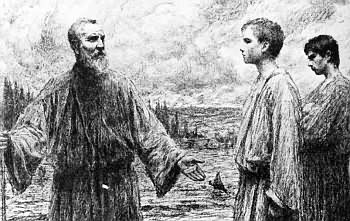
Hoffman

"One thing however you lack: Sell all of your possessions and give the money to the poor; thus will you achieve a treasure in the spiritual world—then come and follow me! 

He was sad about these words, for he was very rich. And when Jesus saw him thus, he said, "What hindrances must those overcome who are rich in outer or inner possessions, if they want to enter into the kingdom of God. Sooner would a camel walk through the eye of a needle than a rich man be able to find the entrance to the kingdom of God!" 

Those who heard this said, "Who then can be saved?" 

He said, "For humans alone, it is impossible. It will be possible, however, through the power of God working in them."


Then he took the twelve to himself and said, "Now we are going up to Jerusalem, and everything which the prophets have written about the Son of Man will fulfill itself: He will be given over to the peoples of the world; they will mock and taunt him, they will spit upon him and scourge him and kill him, but on the third day he will rise up from the dead." 

Yet his disciples understood nothing of all this. The meaning of his words remained hidden from them, and they did not recognize what he was trying to tell them.

2nd February Trinity

February 14, 2021

Luke 18:18-27, 31-34 

Here in the Northern Hemisphere, we are

looking forward to the richness of spring and summer's fullness; but below the equator, autumn and winter are approaching. This is a picture of a great truth on the soul level: Like the whole of the earth, over the whole of a lifetime, no matter what our riches, we must pass through loss and death to arrive at a new life. 

This is brought home to the rich young man in the gospel reading. He is rich, both inwardly and outwardly; he is in the summer of his development.  But Christ is asking him to take the next step—a step into an autumn shedding, the step into a winter sleep. He is to become a Lazarus, one who leaves behind a topside wealth for the good of others and lays down his life. 

At this moment in the gospel, the young man is very sadꟷhe already experiences the grief of loss. But in following Christ, he will be called forth to a whole new level of being. His loss and death will be real and complete. But so will be his completely new and unforeseen lifeꟷfor Christ will intimately and continuously accompany his further developmentꟷthrough loss and death, and into a further life. 

Mary Oliver says: 

Every year

everything

I have ever learned


in my lifetime


leads back to this: the fires

and the black river of loss

whose other side


is salvation

….

To live in this world


you must be able

to do three things:

to love what is mortal;

to hold it


against your bones knowing

your own life depends on it;

and, when the time comes to let it go,

to let it go.*


*Mary Oliver, "In Blackwater Woods."


www.thechristiancommunity.org

Sunday, February 7, 2021

1st Trinity I, Integrity


1st Trinity I

Matthew 20:1-16

"The kingdom of the heavens is like a man, the master of his house, who went out early in the morning to hire workers for his vineyard. Agreeing to pay them one denarius a day, he sent them out into his vineyard.

"At about nine o'clock, he went out

Burnand
and saw others standing in the marketplace, and he said to them, 'Go also into my vineyard, and I will give you whatever is right.' So they went.

"He went out again at about noon and at three o'clock and did the same. At five o'clock, he went out and found others standing there, and he said to them, 'Why do you stand here all day idle?' They said, 'Because no one has hired us.' He said, 'You, too, go into the vineyard.'

Burnand

"And when evening came, the master of the vineyard said to his steward, 'Call the workers and give them their wages, beginning with the last ones hired and going on to the first.'

Burnand

"Those who had been hired at five o'clock came forward, and each received one denarius. Therefore, when it was the turn of those hired first, they expected to receive more. However, they, too, also received one denarius each. They took it, but they began to grumble against the master of the house. 'These men who were hired last only worked one hour, and you have made them equal to us, who have borne the burden of the work and the heat of the day.'

"However, he answered one of them,
saying, 'Friend, I am not being unjust to you. Did you not agree with me for one denarius? Take what you have earned and go. I wish to give to the one hired last the same as I give to you. Have I not the right to do as I wish with what is mine? Or do you give me an evil look because I am generous?'

"Thus will the last be first and the first will one day be last."


First Trinity I

February 7, 2021

Matthew 20:1-16

In the business world, what one is paid is often kept secret. This practice allows the owner to hire people as cheaply as possible, by the hour even.

The gospel presents an interesting work

Byzantine, Workers in the Vineyard
situation involving full disclosure. The master contracts openly with each worker for the standard day-laborer wage, for just enough to support their life for a day, no matter how long or short they had worked. Those working more hours did not earn more. Nor did those who worked fewer make less. Each simply received enough for the day’s need, for working together as long as they could. The day’s wages are given based on daily needs and human dignity, not on the number of hours worked.

Christ offers this story as a likeness of the

Codex aureus Epternacensis, 11th cent.

kingdom of the heavens, which is a kingdom arising in human hearts. He shows us that expecting more than, more than what others get, more recognition, more praise, more rewards than others, is not what we human beings on earth have actually contracted for; for the true being of the economic sphere flourishes in an atmosphere of brotherhood.

We have all agreed to work on fields of earth. Our work on earth gives us the opportunity to earn both the integrity of our selfhood (symbolized by our one denarius) and at the same time to build a healthy relationship to our fellow workers.

In order to develop both, we must avoid comparisons. Some come early to working on the fields of the kingdom, some late. Comparing ourselves with others and expecting more for ourselves is deadly here. It poisons both our integrity and our cooperation. For we have no way of knowing another human being’s true standing in God’s kingdom. And we have no right to denigrate their contribution to the work.

All we can be sure of is that the Master’s task is urgent—the harvest needs to be brought in. The work needs to be done, and we need all the workers we can get. It’s not about what is more advantageous to me or even about what appears to be fair. We are all working for the Father. The Father will give us what we need for our daily bread: the strength we need to maintain our integrity and work well with others.


Sunday, January 31, 2021

4th Epiphany 2021, Get Going

4th Epiphany

John 5:1-16

Sometime later, there was a Jewish feast, and Jesus went up to Jerusalem. Now

Robert Bateman
there is in Jerusalem, near the Sheep's Gate, a pool called Bethesda in Hebrew, which is surrounded by five covered porches. Here lay a great many invalids, the blind, the lame, the paralyzed, waiting for the water to begin moving. For from time to time, a powerful angel of the Lord descended into the pool and stirred up the waters. The first one in the pool after such a disturbance would be healed of whatever ailment he had.

And there was a certain man there who had been an invalid for 38 years. When Jesus saw him lying there and became aware that he had been ill for so long, he asked him,

"Do you want [have the will] to become whole?"

The invalid answered him, "Lord [or, Sir], I have no one to help me into the pool when the water is stirred. While I am trying to get in, someone else goes down ahead of me."

Then Jesus said to him, "Rise up, take up your pallet, and walk." At once, the man was healed and picked up his pallet and walked.

However, it was the Sabbath on that day. Therefore the Jewish leaders said to the man who was healed, "It is the Sabbath; the law forbids you to carry your pallet."

But he replied, "The man who healed me said to me, "Take up your pallet and walk!"

And they asked him, "Who is the man who said to you, 'take it up and walk'?" But the one who was healed had no idea who it was, for Jesus had slipped away, as there was a crowd in the place.

Later, Jesus found him in the Temple and said to him, "Take to heart what I say: Behold, you have become whole. Sin no more, lest your destiny bring you something worse."

The man went away and told the Jewish leaders that Jesus was the one who had healed him. That is why they persecuted Jesus and sought to kill him because he did these things on the Sabbath.

 4th Epiphany

January 31, 2021

John 5:1-16

Jesus asked the invalid, 'Do you want to become whole?'

The simple answer to this question is either a 'yes' or a 'no.' But the invalid gives the usual human answer—an explanation tied to past failure—‘yes, but . . . it never worked.'

Yet one clear statement from Christ gives the man his future: "Rise up, take up
your pallet and walk!"

Christ's words have the power to create. When he gives what seems like a command, it is no mere directive. It is a description of the way forward in human destiny. At the same time, the creative power of his words gives the strength through which human beings can accomplish what is indicated.

The situation with the man suffering from life-long weakness is a picture for us all. So Christ's words to him are also addressed to us.

'Rise up,' he says. 'Don't just lie there and bemoan your fate. Make the effort to overcome the obstacles and weaknesses that drag you down. I will give you the power.'

'Take up your pallet, your bed,' he says. We have a saying: You made your bed, now lie in it—meaning that we need to accept the consequences of our actions. Some illnesses are meant to be borne; some are meant to be overcome. By encouraging the invalid to pick up the bed he was lying on, Christ is encouraging us all not to try to escape our fate but to carry it along with us by bearing it more actively. Christ gives us the strength to accept our fate, actively take it up and make our fate into a destiny in which we actively and creatively participate.

'Walk,' Christ says. 'Move along, get going. Take that next step. Keep going forward along the path of your own life. I am walking beside you.'

In the past, the Father ordered the karmic consequences of the morality of our deeds. But now Christ gives us the power, the strength, the assistance to shape our fate into a destiny we help create. Rise, take up your fate, create your destiny, walk forward into your future. Now Christ encourages us to take his creating words into our hearts.