Sunday, February 9, 2020

1st February Trinity, Gratitude


February Trinity
Matthew 20: 1-16

[But many who are last will be first, and many who are first will be last.] The kingdom of the heavens is like a man, the master of his house, who went out early in the morning to hire workers for his vineyard. Agreeing to pay them one denarius a day, he sent them out into his vineyard.

At about nine o’clock, he went out and saw others standing in the marketplace, and he said to them, “Go also into my vineyard, and I will give you whatever is right.” So they went.

He went out again at about noon and at three o’clock and did the same. At five o’clock, he went out and found others standing there, and he said to them, “Why do you stand here all day idle?” They said, “Because no one has hired us.” He said, “You, too, go into the vineyard.”

And when evening came, the master of the vineyard said to his steward, “Call the workers and give them their wages, beginning with the last ones hired and going on to the first.”

Those who had been hired at five o’clock came forward, and each received one denarius. Therefore, when it was the turn of those who were hired first, they expected to receive more. However, they too also received one denarius each.
Burnand
They took it, but they began to grumble against the master of the house. “These men who were hired last only worked one hour, and you have made them equal to us, who have borne the burden of the work and the heat of the day.”

However, he answered one of them, saying, “Friend, I am not being unjust to you. Did you not agree with me for one denarius? Take what you have earned and go. I wish to give to the man hired last the same as I give to you. Have I not the right to do as I wish with what is mine? Or do you give me an evil look because I am generous? Thus will the last be first and the first will one day be last."


1st February Trinity
Feb 9, 2020
Matthew 20:1-16

The story in today’s reading seems to be about fairness. Those who worked the entire day feel entitled to more than a day’s wage, because those who seemed to do less received the same day’s wage.

van Gogh
But on a social level, the story is actually about a generosity that is beyond fairness. The master, the great and generous heart of the world, would give daily bread, sustenance to all. Human dignity requires that all be sustained, regardless of circumstance. That is also our own human task—to work to feed others, not just ourselves.

On yet another level, this story is also about the broader reasons we labor on earth at all. Each day we come back from the fields of night, where we received our inspirations for the work of earth. We are all day laborers working on our own sense of self, our own integrity, our own great-heartedness. To be without outer work is to suffer a loss of meaning, loss of relationships to others, loss of a sense of self, and one’s place in the community.

For we have all come to labor on the fields of earth to build up our own inner strength, and to join with others in doing God’s work of earth, even if we appear to have no outer job at all. The poet Mary Oliver wrote:

My work is loving the world.

….Let me
keep my mind on what matters,
which is my work,

which is mostly standing still and learning to be
astonished.
Which is mostly rejoicing….

which is gratitude, to be given a mind and a heart
and these body-clothes,
a mouth with which to give shouts of joy
to the moth and the wren, to the sleepy dug-up clam,
telling them all, over and over, how it is
that we live forever.*


*Mary Oliver, “Messenger,” in Thirst


Sunday, February 2, 2020

4th Epiphany 2020, Restoring

4th Epiphany
Luke 13: 10-17

Kenneth Dowdy
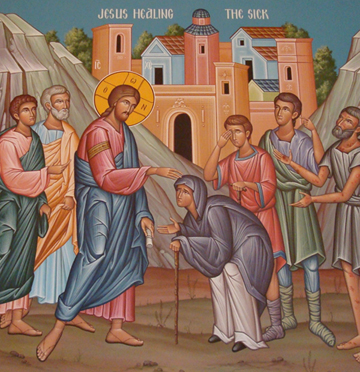
Once he was teaching in a synagogue on the Sabbath. And behold, there was a woman who had a spirit weakening her for eighteen years: she was bent over and could not stand upright [lift her head all the way up]. When Jesus saw her, he called her to him and said to her, “Woman, you are released from your illness!”

He laid his hands upon her, and at once she was able to straighten up. And she praised the power of God. Then the leader of the synagogue, indignant because Jesus had healed on the Sabbath, said to the people, “There are six days for doing work; on those days you can come and let yourselves be healed—but not on the Sabbath.”

But the Lord replied, “You hypocrites! Does not every one of you untie his ox or his ass from the manger on the Sabbath and lead it away to the water trough? But this daughter of Abraham, who was held bound by the dark might of Satan for eighteen years, wasn’t supposed to be released from her bondage on the day of the Sabbath?”


All his opponents were put to shame by these words, and the people rejoiced over all the signs of spiritual power that happened through him.

4th Epiphany
February 2, 2020
Luke 13: 10-17

Tissot
The woman in the Gospel could not stand upright. She was subject to the hardening imprisonment of the adversary. The effect of such imprisonment was likely painful misery, a sense of being severely hampered, forced to face earthward like an animal, cut off.

Jesus is in the synagogue teaching. It is the Sabbath, the day of rest, the day for remembering back to the human being’s divine origins. It is the day for remembering how God created human beings in His own image and likeness: radiant with light, bursting with life, exuding love.

Christ, the Creator, calls the woman to him. And she responds to his call. The power of his divine, creating Word releases her soul and spirit from the adversary’s dark might. Then Christ places his hands on her and creates her anew. She rises upright. The image of the original human being is restored in her. Once more, she is the picture of humanity: head in the stars, feet firmly planted on the earth, heart free.

But there are others there whose souls continue to be bound by Satan’s dark power. They indignantly chastise Him and all the others for doing work on the Sabbath instead of resting and remembering. How ironic that for them, remembering how human beings once were, seems more important than re-creating, restoring the human being in front of them.

And Christ’s response once again overcomes the dark power that works, not only in human bodies but also in human souls. For love and goodwill, like water, like sunshine, will flow outward wherever needed. To stop Christ’s will is to darken the sun, to dam up the life-giving waters.

The results of Christ’s admonishment are shame and joy. Shame for what we recognize in ourselves. Joy in recognizing the healing warmth of the Christ-Sun. And hope—the hope of healing for all humankind

As Denise Levertov says:

It’s when we face for a moment
The worst our kind can do, and shudder to know
The taint in our own selves, that awe
Cracks the mind’s shell and enters the heart:
Not to a flower, not to a dolphin,
To no innocent form
But to this creature vainly sure
It and no other is god-like, God
(out of compassion for our ugly
failure to evolve) entrusts,
As guest, as brother,
The word.*

* “On the Mystery of the Incarnation”, in The Stream and the Sapphire, by Denise Levertov, p. 19


.


Sunday, January 26, 2020

3rd Epiphany 2020, Whatever He Tells You

3rd Epiphany
John 2, 1-11

Egbert Codex
On the third day, a wedding took place in Cana in Galilee and the mother of Jesus was there. And Jesus and his disciples were also invited to the wedding.

When the wine ran out, Jesus’ mother said to him, “They have no more wine.”

And Jesus answered her, “Something still weaves between me and you, O Woman. The hour when I can work out of myself alone has not yet come.”

Then his mother said to the servants, “Do whatever he tells you.”

There were six stone jars set up there for the Jewish custom of ceremonial washing, each containing twenty to thirty gallons. Jesus said to them, “Fill the jars with fresh water.”

And they filled them to the brim. And he said, “Now draw some out and take it to the Master of the feast. And they brought it to him.
Woloschina

Now when the Master of the feast tasted the water that had become wine, not knowing where it came from—for only the servants who had drawn the water knew—he called the bridegroom aside and said to him, “Everyone serves the choice wine first, and when the guests have drunk, then the lesser; but you have saved the best until now.”


This, the beginning of the signs of the spirit which Jesus performed among men happened at Cana in Galilee and revealed the creating spiritual power that worked through Him. The disciples’ hearts opened, the power of faith began to stir in them, and they began to trust in him.

3rd Epiphany Sunday
January 26, 2020
John 2, 1 – 11

In ancient times, human consciousness of self was weak and dreamy. At that time, drinking a small amount of wine had the effect of awakening and strengthening self-awareness.

Christ’s first spiritual sign was enacted at a wedding, at a celebration of the union of the masculine and feminine halves of the human being. The fact that the couple had run out of wine symbolizes the state of humankind in general—the time for alcohol as a valid strengthener of the ego has run out. Mankind needs a new source for the strengthening of the self.

At the same time, the joining of masculine and feminine forces is also celebrated at this wedding event on another level. At this early stage in Christ’s working, He needs the compassionate heart force of the Soul-Mother, grounded as it is in earthly and social realities. It is as though through her, He can connect with Mother Earth and draw up the strengthening force for the human self from her depths. He who will later say, “I am the Vine, you are the branches,” John 15:5, begins to root Himself into the depths of earth. He begins the work of transformation, transforming the watery depths into the sun-drenched strengthening power of the grape. Through Him, Water becomes for the self the strength and effervescence of the best possible Wine.

This event foreshadows the Last Supper, when He, the Vine, transforms fruit of
Christ in the Winepress
the vine into the sacrificial strength of His Blood. On the cross, the Vine will pour His blood into Mother Earth, giving back to her of Himself and strengthening her. Thereby He quietly strengthens and grounds all humankind for our work on earth.

In the Eucharist, we choose to consciously receive the power of His blood into our bodies of earth; we receive the power of His blood into our weakened souls so that something of a wedding begins to take place. Something begins to weave between Him and us, between His Self and our selves. A kind of wedding song, a song of call and response, begins to ring forth.

“I am the Vine, you are the branches, Whoever abides in me will bear much fruit.” John 15:5
And we answer, ‘What shall we do, Lord?’
“The hour when I can work out of myself alone has not yet come.” John 2:4
How can we help, Lord?

“Without the strength of my I AM, you can do nothing. John 2:4 As the Father has loved me, so have I loved you. Abide now in my love. John 15:9

And we answer, ‘Yes Lord, take us in exchange for having given yourself to us. Now, what shall we do?’

And the intimate and encouraging refrain of his mother’s answer echoes down through the ages: ‘Do whatever He tells you.’ John 2:5