Sunday, January 21, 2018

3rd Epiphany 2018, Integrate the Feminine

Woloschina

3rd Epiphany

John 2, 1-11

On the third day, a wedding took place in Cana in Galilee and the mother of Jesus was there. And Jesus and his disciples were also invited to the wedding.

When the wine ran out, Jesus’ mother said to him, “They have no more wine.”

And Jesus answered her, “Something still weaves between me and you, o Woman. The hour when I can work out of myself alone has not yet come.”

Then his mother said to the servants, “Do whatever he tells you.”

There were six stone jars set up there for the Jewish custom of ceremonial washing, each containing 
twenty to thirty gallons. Jesus said to them, “Fill the jars with fresh water.”

And they filled them to the brim. And he said, “Now draw some out and take it to the Master of the feast. And they brought it to him.

Now when the master of the feast tasted the water that had become wine, not knowing where it came from—for only the servants who had drawn the water knew—he called the bridegroom aside and said to him, “Everyone serves the choice wine first, and when the guests have drunk, then the lesser; but you have saved the best until now.”

This, the beginning of the signs of the spirit which Jesus performed among men happened at Cana in Galilee and revealed the creating spiritual power that worked through Him. The disciples’ hearts opened, the power of faith began to stir in them, and they began to trust in him.

3rd Epiphany
January 21, 2018
John 2: 1-11

Often the way and manner in which a thing begins become the template. How things begin can imprint a kind of signature on how 
they will continue.

This wedding at Cana is the first sign of Christ’s working. He works with the earth, with the feminine, with humanity.

The mother, the feminine soul, sees the need for more wine; she is aware of the social implications. And she represents perhaps an awareness of the empty spiritual state of humanity. At this point, Christ is a kind of newborn, fresh from His Baptism. His feminine side is still operating from outside himself, through the mother. Yet in trust, she leaves up to Him what he will do -  ‘do whatever he tells you,’ she says. And
He draws up pure, fresh, effervescent water from Mother Earth herself. The water is so full of life, so stimulating, that it is indistinguishable from wine.

In time He will integrate the feminine into 
Himself and will be able to work ‘out of himself alone.’ He himself will become the Vine that reaches deep into the earth. He will change the waters of earth into the wine of His blood. He will pour it out in offering to both to the earth and to all of humanity.  He, today the wedding guest, will tomorrow become the Bridegroom. He will become the King’s Son at the marriage feast. He will wed the Soul of Humanity. Together, He and we will bear much fruit.

Sunday, January 14, 2018

2nd Epiphany 2018, Spirit Child

2nd Epiphany
Luke 2, 41-52

Every year his [Jesus’] parents went to Jerusalem for the feast of the Passover. And when he was twelve years old, they took him with them. Now after they had gone there and fulfilled the custom during the days of the feast, they set off on their way home. But the boy Jesus remained behind in Jerusalem. His parents did not know this; they thought he was among the company of the travelers. After a day’s journey, they missed him among their friends and relations. When they did not find him, they returned to Jerusalem to look for him.

After three
Durer
days they found him in the Temple, sitting in the midst of the teachers, listening to them and asking them questions. And those who heard him were amazed at his mature understanding and his answers.

And when they saw him, they were taken aback, and his mother said to him, “My child, why have you done this to us? Behold, your father and I have been searching for you in great distress.”

And he said to them, “Why did you look for me? Did you not know that I must be and live in that which is my Father’s?”

But they did not understand the meaning of the words he spoke to them. And he went down with them again to Nazareth and followed them willingly in all things.

And his mother carefully kept all these things living in her heart. And Jesus progressed in wisdom, in maturity and grace [favor] in the sight of God and man.


2nd Epiphany
January 14, 2018
Luke 2:41-52

For perhaps long periods of time the stream of our life flows smoothly. Then suddenly something unexpected happens—a great event, a loss, a chance encounter, and something new breaks forth.

In today’s 
reading, this moment in the life of the young Jesus is just such a moment. It is a kind of second birth. For three days he was cocooned in the Temple as His soul was being born. The child is becoming a man. Things can no longer be what they once were. For a moment, the light flares up in great promise, awakening both fear and hope. The mother ponders this in her heart. But His parents’ grief and confusion over the loss of the sweet, uncomplicated child will ultimately be a gain for all of humanity.

But it is not yet time. The Spirit Child has a further path before him. And so he covers the flame again. He goes home in humble submission to his earthly parents, to grow, to progress, to mature. The poet expresses this moment:

I cover the divine flame in my heart
for if I turned God loose from my house
the earth would reveal to your eyes what mine always see—
existence is a lamp, and I …
the oil it
burns.*

We, too, are nurturing a spirit child. He is brought to birth in prayer, in the Act of Consecration of Man. We hear Him speak of what belongs to the Father. We don’t always understand. But we ponder in our hearts. And we carry Him home, and out into the world with us where we, too,  ‘progress in wisdom, in maturity and grace in the sight of God and man.’ Luke 2: 52.

*“The Oil It Burns”, by Kabir, in Love Poems from God, Daniel Ladinsky, p. 234.

Saturday, January 13, 2018

1st Epiphany 2018, Innocence Grown

Tissot
1st Epiphany
Matthew 2: 1-12 
 
When Jesus was born in Bethlehem in Judea—during the time of King Herod—behold: wise priest-kings from the east arrived in Jerusalem, saying,
           
“Where is the one born here King of the Jews? We have seen his star rise in the east and have come to worship him.”
           
When King Herod heard this, he was deeply disturbed, and all Jerusalem with him. And he assembled all the high priests and scribes of the people and inquired of them in what place the Christ was to be born.
 
And they said to him, “In Bethlehem of Judea, for thus it was written by the prophet:
 
And you Bethlehem, in the land of Judah,
Are by no means the least among the rulers of Judah;
For out of you shall come forth the ruler
Who will be shepherd over my people, the true Israel.”
 
Then Herod, secretly calling the Magi together again, inquired from them the exact time when the star had appeared. He directed them to Bethlehem and said, “Go there and search carefully for the child, and when you find him, report to me, that I too may go and bow down before him.”
 
After they had heard the King, they went on their way, and behold, the star that they had
seen rising went before them, and led them in its course over the cities until it stood over the place where the child was.
 
Seeing the star, they were filled with [there awakened in them] an exceedingly great and holy joy.
 
Entering the house, they saw the child with Mary his mother; they fell down before him and worshipped him. Then they opened their treasures and offered him their gifts: gold and frankincense and myrrh.
 
And having been warned in a dream not to return to Herod, they departed to their country by another way.
           
1st Epiphany
January 7, 2018
Matthew 2: 1-12
 
There is an archetypal polarity in the world: whenever innocence, goodness, beauty or purity appear, there, immediately, is the predator. The one attracts the other. It is as though innocence and destruction are paired, as though they are destined to wed.
 
So it is no wonder that the innocent child Jesus attracts the attention of Herod. The child will escape death this time. It is protected by the angels, for its time has not yet come. But Innocence Grown will be murdered by the same predatory pride and fear that expressed itself in Herod.
 
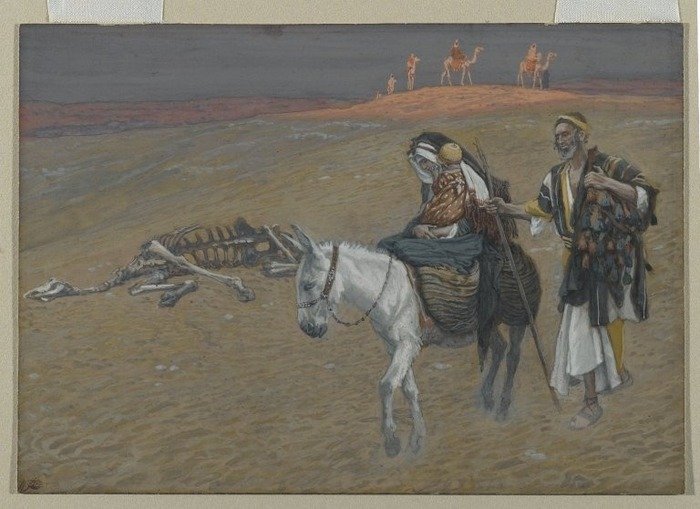
Tissot, Brooklyn Museum

Yet that won’t be the end of the story. It will be just the beginning. For Innocence will not be utterly destroyed. Innocence Grown will wed itself to the destroyer Death. It will take the predator by the hand and lead it through hell into the light of love. It will die, but it will rise again as New Life.
 
When Herod says, “…search carefully for the child, and when you find him, report to me, that I too may go and bow down before him,’ we hear the lie, the irony in his words. Yet Herod was speaking an unconscious truth. For what the destroyer really wants is redemption. And it will happen, because Innocence Grown loves all—Herod, the Pharisees, all human souls.
 
The Destroyer lives inside each of us. It is the necessary partner to our innocent, untouchable spiritual core. It challenges us to find the pathway to Innocence Grown, to the one who shines in the darkness as our own New Life.